How to choose a bedroom lamp
A bedroom is the one room where light isn't there to help you see better, but to help you settle. That changes almost every criterion.
6 min read·
Ambient light is not task light
Task light is directional and bright — for reading, for getting ready, for work. Ambient light is diffuse and dim, and its job is to set the room's tone. Most bedrooms need both, but from different fixtures: one directed lamp for reading, and one soft source that stays on while the room winds down.
The mistake we see most often is asking one lamp to do both jobs. It ends up either too bright for the evening or too weak for a book. If you're buying only one, be honest about which role you actually use every day.
Colour temperature: why 2700–3000 K
Light colour is measured in kelvin. Around 2700 K is warm and yellowish, close to an old incandescent bulb; 3000 K is still warm but a little cleaner. From 4000 K upward light goes neutral and then cool-blue — good for a kitchen or bathroom, bad for a bedroom.
The reason isn't only aesthetic. The blue end of the spectrum is exactly what the body reads as daylight, so cool light in the evening pushes sleepiness back. A lamp burning in the last hour before bed should be warm and dim. Ours run at 3000 K for that reason.
Height, placement and how much light is enough
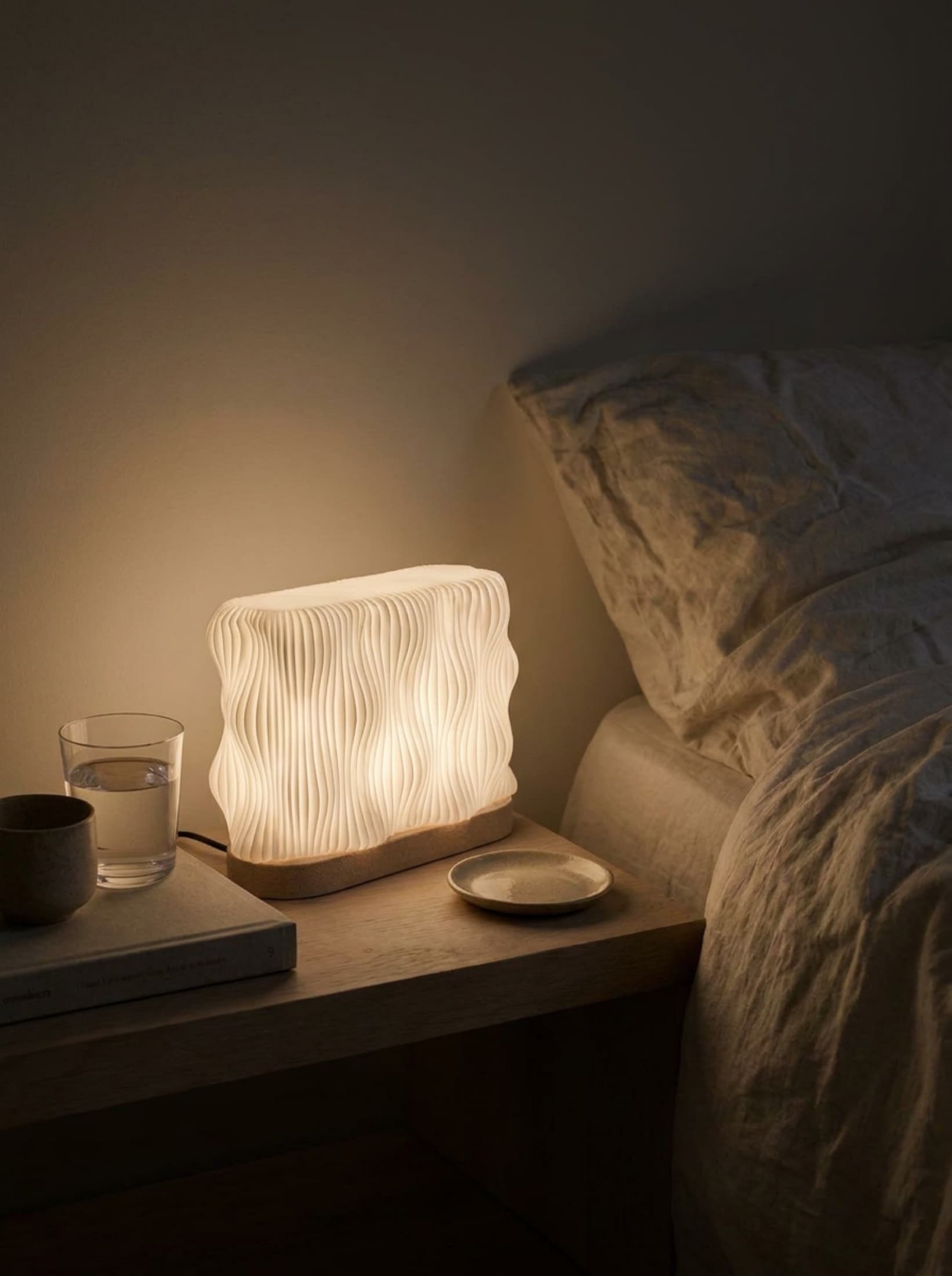
One rule holds whatever the shape: sitting up in bed you should never look straight at a bare light source. On a classic shaded lamp that means around 40 cm tall, so the bottom of the shade lands at eye level. On a closed, diffusing form like ours the source is hidden anyway, so 15 to 25 cm is plenty — the Monowave is 17.5 cm and the Mini 22 cm, and on a nightstand both glow as a surface rather than a point.
For ambient light, direction matters more than power. A lamp turned toward a wall throws a soft, diffused glow back into the room and lights it more evenly than a stronger lamp aimed at the middle of the floor. If the lamp has texture — like our wave form — that glow becomes part of the décor once it's dark.
Common questions
- How many lumens for a bedside lamp?
- For ambient light, 200–400 lumens is enough. If you also read by it, aim for 400–800 — or better, use two sources, one soft and one directed.
- Do 3D-printed lamps get hot?
- With an LED source, barely — an LED turns most of its energy into light rather than heat, and the lamp stays lukewarm to the touch. Incandescent and halogen bulbs are another matter and don't belong in a printed body.
Where to next
Got a project in mind?
Describe what you need and we'll come back with an estimate and a date within 24–48h.
Request a quote